
Stocks Slide as Banks Weigh, Tech Weakness Persists | January 14, 2026 Market Close Analysis
Unlock More Features
Login to access AI-powered analysis, deep research reports and more advanced features
About us: Ginlix AI is the AI Investment Copilot powered by real data, bridging advanced AI with professional financial databases to provide verifiable, truth-based answers. Please use the chat box below to ask any financial question.
Related Stocks
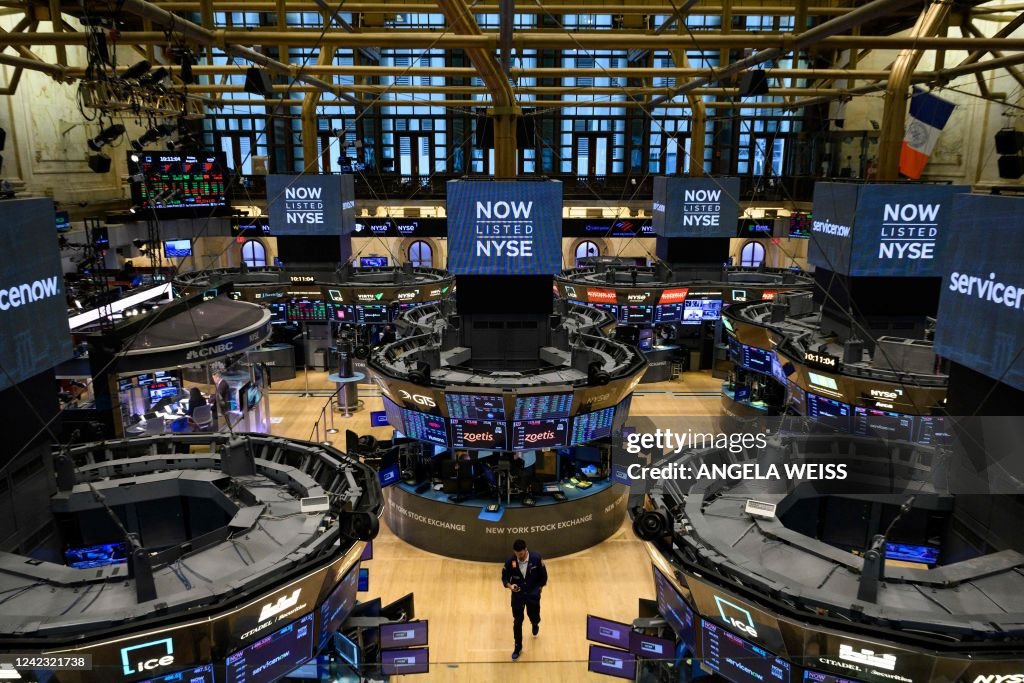
The January 14, 2026 trading session marked the first back-to-back losses of 2026 for major U.S. indices, as investors responded to disappointment in bank earnings reports and persistent weakness in the technology sector. The closing bell coverage from Bloomberg Television, hosted by Romaine Bostick, David Gura, Carol Massar, and Tim Stenovec, documented a day of notable sector rotation characterized by defensive outperformance and growth-sector weakness [Bloomberg YouTube].
The session revealed significant divergence among major indices, with the technology-heavy NASDAQ Composite recording its biggest single-day decline in a month, while the Dow Jones Industrial Average managed modest gains and the small-cap Russell 2000 demonstrated relative strength with a near-0.8% advance. This pattern suggests investors were shifting toward domestically-focused, smaller-capitalization stocks in response to evolving risk perceptions [0][1][4].
The market’s sector composition on January 14, 2026 displayed a clear rotation from growth to value orientations. Consumer Defensive emerged as the strongest sector with a 1.01% gain, followed by Financial Services at +0.76%, Healthcare at +0.64%, and Industrials at +0.60%. These defensive and economically-sensitive sectors attracted inflow as risk-off sentiment took hold [0].
Conversely, Consumer Cyclical suffered the steepest decline at -0.89%, followed by Technology at -0.85%, Communication Services at -0.43%, and Basic Materials at -0.32%. The technology sector’s underperformance was particularly pronounced, with major components including Microsoft (-2.40%), Amazon (-2.50%), Meta Platforms (-2.50%), Broadcom (-4.02%), Oracle (-3.16%), and Tesla (-1.99%) all recording significant losses [1][4].
The Russell 2000’s relative strength (+0.78%) compared to the NASDAQ’s decline (-0.39%) indicates a rotation toward domestically-focused small-cap equities, which historically perform better when investors are concerned about international trade tensions or seeking more value-oriented exposures [0][4].
The banking sector faced substantial pressure despite mixed earnings results. Wells Fargo (WFC) declined 1.65% on the session, closing at $89.25 with elevated trading volume of 33.67 million shares. The bank’s struggles were attributed to missing revenue estimates and persistent regulatory concerns, which contributed to broader sector anxiety despite Bank of America reporting strong earnings [1].
Citigroup © also faced pressure, declining 3.3% following its earnings release, while the SPDR Financials ETF recorded a 2.33% decline over the trailing five sessions [1][3]. The sector faces multiple headwinds, including a proposed Administration policy that could cap credit card interest rates at 10% for one year—a measure that could materially impact bank revenue streams [1][4].
The technology sector led market declines, with artificial intelligence-related stocks experiencing particular pressure. Nvidia (NVDA) declined 0.64% to close at $183.14, as investors showed signs of cooling on AI investments amid overvaluation concerns. The semiconductor segment faced additional pressure from reports that Chinese customs authorities have advised agents that Nvidia’s H20 AI chips are not permitted to enter China, adding a geopolitical dimension to sector weakness [2][3].
Microsoft (MSFT) declined 2.40% to $459.38, representing a significant drag on the NASDAQ and S&P 500 given its substantial market capitalization. The broad-based tech weakness reflects investor reassessment of AI-related valuations following an extended rally period [1].
Several factors contributed to the risk-off sentiment observed during the session:
Risk-off sentiment drove notable moves in precious metals, with gold futures rising 0.8% to $4,626 per troy ounce and silver settling up 5.8% at $90.87 per troy ounce—a new all-time high approaching $92. These moves reflect investor flight to traditional safe-haven assets amid elevated uncertainty [3][5].
The January 14 session reveals several interconnected market dynamics. The rotation from growth to value sectors coincides with reassessment of AI-related valuations following an extended rally, suggesting investors are becoming more discriminating about growth exposures amid elevated valuations and geopolitical uncertainty.
The banking sector’s struggles despite mixed earnings illustrate how regulatory and political factors can outweigh fundamental performance in determining market outcomes. The proposed credit card rate cap represents a potential material headwind that could reshape bank business models and profitability.
The divergence between the Russell 2000’s strength and NASDAQ’s weakness suggests investors are repositioning toward domestically-focused, smaller-capitalization stocks that may be less exposed to international trade tensions and currency fluctuations.
- Federal Reserve policy uncertainty due to institutional tensions represents a high-priority monitoring concern with potential implications for interest rate trajectories
- Bank sector outlook remains mixed, with strong individual earnings offset by regulatory and political risks
- Technology sector valuations appear extended, with the AI rally showing signs of fatigue
- Credit card rate cap proposals could materially impact bank revenue if implemented
- Geopolitical exposure remains elevated with multiple global flashpoints
The analysis reveals risk factors that warrant attention from market participants, including institutional tensions affecting monetary policy continuity, sector-specific regulatory concerns, and evolving geopolitical developments that could influence market direction [0][1][3].
This session represents a rotation from growth to value as investors responded to earnings disappointment in financials, persistent technology valuation concerns, and elevated geopolitical uncertainty. The S&P 500’s back-to-back declines marked the first such streak of 2026, while the Russell 2000’s relative strength suggests continued market bifurcation. Defensive sectors outperformed while Technology and Consumer Cyclical led declines. Safe-haven flows into precious metals and domestically-focused equities indicate elevated risk aversion among market participants.
Insights are generated using AI models and historical data for informational purposes only. They do not constitute investment advice or recommendations. Past performance is not indicative of future results.
About us: Ginlix AI is the AI Investment Copilot powered by real data, bridging advanced AI with professional financial databases to provide verifiable, truth-based answers. Please use the chat box below to ask any financial question.